Northern Manitoba — 1,000 km from Winnipeg
Churchill,
Manitoba
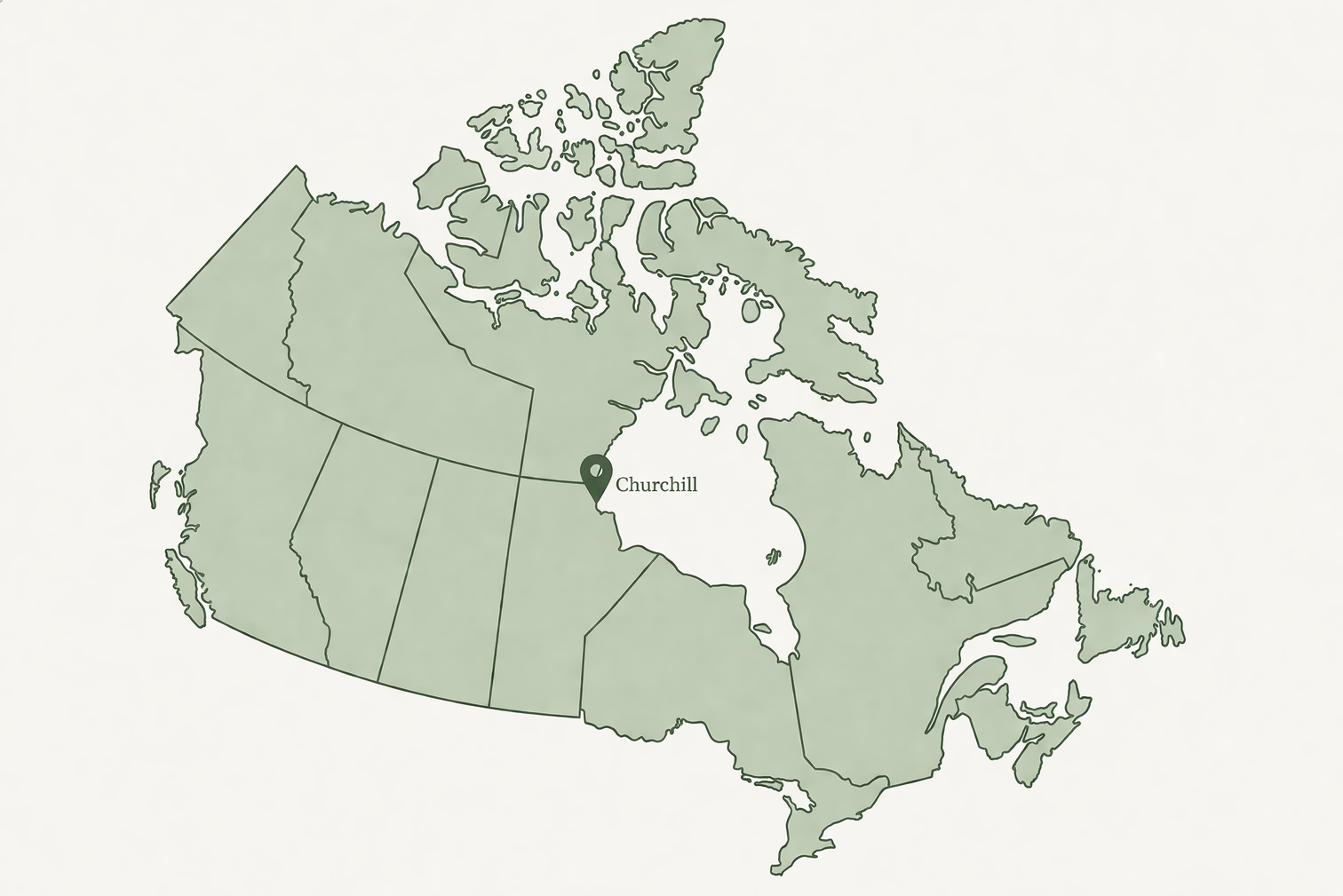
A town of roughly 900 people on the shore of Hudson Bay. With no roads in or out, everything depends on a single railway line.
Northern Manitoba — 1,000 km from Winnipeg
A town of roughly 900 people on the shore of Hudson Bay. With no roads in or out, everything depends on a single railway line.
The Basics
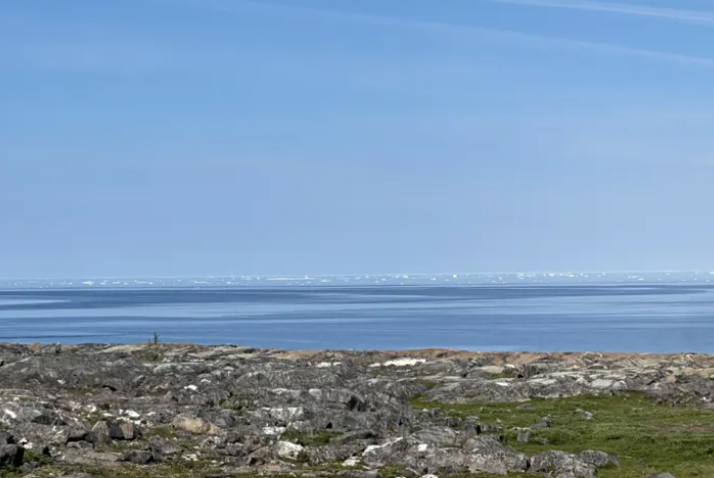
Churchill is a remote subarctic town located approximately 1,000 km north of Winnipeg on the western shore of Hudson Bay. It sits at the convergence of three major biomes: boreal forest, tundra, and marine. It is one of the most ecologically unique places in Canada.
About 900 people call Churchill home year-round. Around 55% (or just over half) of residents identify as Indigenous, including Cree, Dene, Chipewyan, Métis, and Inuit peoples. The town is known internationally as the "Polar Bear Capital of the World," drawing 10,000 to 12,000 eco-tourists annually.
For all its natural significance, Churchill has no roads connecting it to the rest of Canada. Food, fuel, medicine, and building materials all arrive by train or, at considerably greater cost, by plane.
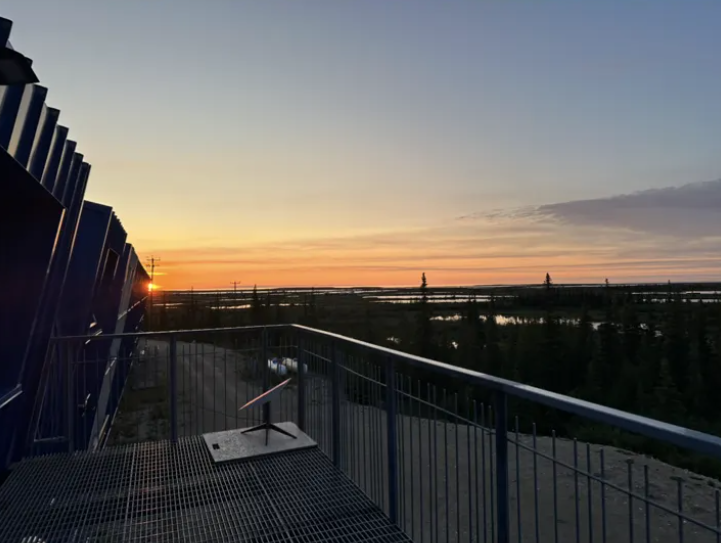
Sunset viewed from the Churchill Northern Studies Centre. Photo by the site creator.
The Lifeline
The Hudson Bay Railway stretches roughly 1,300 km across northern Manitoba, connecting Churchill to The Pas and the rest of Canada's rail network. Construction began in 1906 and the line reached Churchill in 1929, built largely on permafrost and muskeg. It is, in practical terms, Churchill's only reliable link to the rest of Canada.
"Everyone in this town feels held hostage."
— Rhoda de Meulles, Churchill hardware store owner, after the 2017 rail washout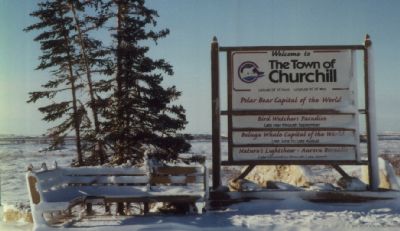
While Churchill has air access, a round-trip flight from Winnipeg alone can exceed $1,000, and air freight costs three to six times more than rail. For a town that needs to import everything it consumes, air is not a realistic option. The railway carries the load, and the cost of getting goods there is built into every item on the shelf. Groceries in Churchill cost two to four times more than in southern Manitoba.
For groceries, Churchill residents rely on the Northern Store, owned by the North West Company. Because there are no competing retailers, residents have no way to compare prices or seek alternatives.
The Northern Plate
The following prices were documented by the Manitoba Government and General Employees Union (MGEU) in a 2012 price comparison between Churchill and Winnipeg. Current prices are generally higher.
| Item | Churchill (Northern Store) | Winnipeg | Difference |
|---|---|---|---|
| Romaine lettuce (1 head) | $4.59 | $1.49 | 208% more |
| Carrots (small bag) | $6.59 | $1.59 | 314% more |
| Dozen eggs | $5.75 | $2.99 | 92% more |
| Baby formula | $36.69 | $28.99 | 27% more |
| 4L jug of milk (during 2017 crisis) | $10.89 | $6.19 | 76% more |
Source: Manitoba Government and General Employees Union (MGEU), 2012. Crisis prices from CBC News, 2017.
May 2017
In May 2017, catastrophic spring flooding washed out the rail line in 19 locations along a 300 km stretch between Gillam and Churchill. The owner of the railway at the time, Denver-based OmniTRAX, declared force majeure and walked away. The last train sat stranded in Churchill, and rail service would not resume for over a year.
"How can I survive? I can't feed my kids."
— Molly Meeko, single mother of six, Churchill (CBC News, 2017)The community's response was one of resilience and solidarity. Fox Lake Cree Nation partnered with local businesses to construct a 300 km ice road from Gillam to Churchill, Calm Air flew freight in twice weekly, and Winnipeg Blue Bombers alumni organized emergency food drives. Churchill was temporarily added to the federal Nutrition North Canada subsidy program.
In August 2018, the railway was purchased by the Arctic Gateway Group, a partnership now owned entirely by Indigenous and northern communities, though food and fuel prices did not fully recover to pre-crisis levels even after trains returned.
A Local Solution
In October 2017, right as the rail crisis hit, a hydroponic shipping container farm arrived on the last ship of the season to Churchill. The Rocket Greens project, operated by the Churchill Northern Studies Centre, grows over 40 varieties of fresh produce year-round, even at temperatures of -42°C.
Lettuce, kale, spinach, arugula, bok choy, Swiss chard, and fresh herbs grow in a controlled environment and are delivered directly to community members. Two-thirds of the harvest goes to residents via a subscription service. In its first three years, the program produced over 40,000 pieces of fresh produce.
In 2025, the CNSC launched Nourish the North, a program offering free or subsidized Rocket Greens subscriptions to Churchill households who identify cost as a barrier to accessing fresh produce.
Support Rocket Greens →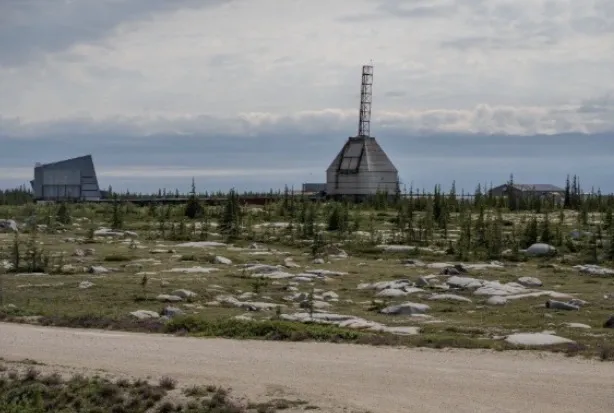
Continue Reading
The food insecurity its residents experience is shared by Indigenous and remote communities across the country.
Explore The North →